
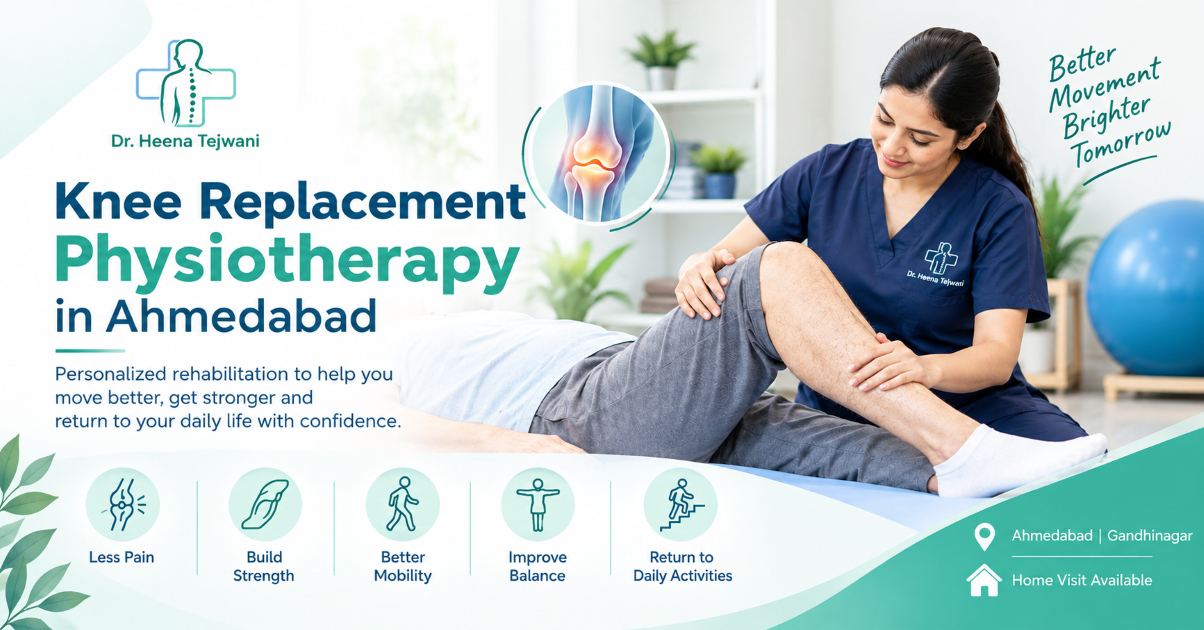
Knee replacement surgery is only the first step of the process in alleviating knee pain and improving function. Physiotherapy is pivotal in helping you enhance your function and safety in performing your daily activities.
Are you in need of Knee Replacement Physiotherapy in Ahmedabad? Dr. Heena Tejwani offers personalized physiotherapy advice for people who have had knee replacement surgery.
Is it True That Physiotherapy After Knee Replacement Helps?
Dr. Heena Tejwani goal of knee replacement surgery is to improve the quality of your life by alleviating knee pain and improving your function. Physiotherapy after surgery helps in achievement of these goals by improving the range of motion of your knee, strength of your legs, and your balance.
Pain, swelling and stiffness of your knee are normal after surgery. Your physiotherapist will address these issues with specific interventions, which may vary from what other patients to the surgery receive.
What to Expect from Physiotherapy after a Knee Replacement?
The focus of the rehabilitation program is to enhance your knee strength and improve your balance in order to help you build your confidence while ambulating.
Physiotherapy is initiated even before you are discharged from the hospital in some situations. Your physiotherapist will teach you various strategies to protect your knee and also demonstrate exercises that you will have to perform routinely.
The rehabilitation program includes various interventions such as:
- Stretching and building the strength of your leg and knee.
- Practicing to stand and walk with balance.
- Practicing to perform activities of your daily living like climbing stairs and getting up from a chair.
- Progressively increasing the activities that you perform.
Interventions included in the rehabilitation program will include different exercises to reduce pain and swelling in your knee.
The strategies and activities that are designed for you should be based on your condition and needs. Thus, following a general exercise list that is available on the Internet will not be of much help.
The Importance of Physiotherapy after Knee Replacement Surgery
After a knee replacement surgery, you may find it difficult to do activities like walking, climbing stairs, getting up from a chair etc. due to stiffness and swelling in your knee and weakness of your legs.
1. Swelling in your knee after surgery limits your movement.
Your physiotherapist will choose exercises and activities to improve the movement and function of your knee within your comfort level.
2. Regaining Muscle Strength
Muscles like the quadriceps are essential for knee movement and assist in walking.
Gaining control of your muscles helps in performing your daily activities. Various exercises to improve knee movements and knee bending strength are provided by orthopedic hospitals during your stay.
3. Learning to Walk Again
Pain and weakness in the knees after surgery sometimes leads to a change in the way an individual walks, and the use of walking aids.
Physiotherapy aims to improve your capability to perform the following:
Control and coordinate your body to shift your center of gravity over your upper or lower limb
- Take stepping actions
- Correct the pattern of your walking
- Build confidence while performing activities of daily living
- Learn to use walking aids
4. Regaining Balance
Your goal should be to recover the ability to do daily activities rather than just to bend your knee.
According to your health condition and status of recovery, the trained personnel may permit you to perform daily activities like sitting, standing, and using stairs.
What Kind of Exercises Should Expected to do After Knee Replacement Surgery?
The type of exercises you will perform after your surgery will depend on your stage of recovery.
Some of the exercises you will perform will be:
- Knee bending
- Extension of your knee
- Movements of your knee
- Ankle movements
Other exercises may focus on improving your balance and performing activities of daily living.
It is normal to perform some of the exercises that are included in your physical therapy program provided by your care team.
What to Expect during Knee Replacement Recovery?
Factors that may impact your recovery include:
- Each person recovers at their own pace
- age and general health
- knee’s condition before surgery
- Type of knee replacement
- Experience and skills of Doctor
- ability to comply with the rehabilitation program
- Other medical problems you may have
It may take several months to a year for you to completely recover from your knee replacement surgery.
While it is normal to set a goal to completely recover in a certain number of weeks, the focus of your rehabilitation should be to progressively improve your ability to move your knee joint, walk and perform activities of your daily living.
Can Physical Therapy Lessen Swelling and Joint Pain?
Swelling and pain after surgery are normal.
Your physical therapist may teach you ways to manage pain and swelling to prevent them from slowing down your recovery. Your team may advise you on other ways to manage pain and swelling including how to position your leg to reduce swelling and other activities to aid in your recovery.
It is normal to treat some degree of pain, swelling and other symptoms of inflammation after surgery, but you should be concerned if you develop any of the following:
- Fever
- Increased pain and/or swelling of your calf
- Inflamed, painful, warm and/or unhealed incisions
- Discharge from your incisions
- New breathing difficulty or pain in your chest
- Decreased level of consciousness
- Severe pain and/or swelling that does not improve with pain relievers and/or other treatment
- These symptoms may require an emergency evaluation.
How Long After Knee Replacement Surgery Should Start Physiotherapy?
The duration and detail of your physiotherapy will be individualized based on your medical condition and your team’s protocol.
Many medical teams will start you on physiotherapy interventions as soon as possible to improve your mobility. The goal of your in-hospital physiotherapy will likely include ambulating and use of mobility aids.
Continue your physiotherapy as an outpatient, or have physiotherapy conducted at your home, if required.
To get more information regarding your stay and rehabilitation after knee replacement in Ahmedabad, contact us.
What will Happen During Knee Replacement Physiotherapy?
Initially, your physiotherapist will assess your condition to decide what your goals and limitations should be.
Possible elements of this assessment may include:
- Your knee’s functional range of motion
- The status of the muscular components of your leg
- Edema
- Pain
- Prioritized goal setting
- Your ability to walk and balance
- Use of mobility aids
- Your goals for the day
After your goals are set and assessed, interventions will be designed to address your goals and help you progress to the next set of goals.
Based on your goals and the functional needs of you and your family, the components of your treatment will be decided. For example, if you are receiving home visit physiotherapy in the Ahmedabad and Gandhinagar regions, your treatment will encompass your home and other components of your life.
What Are the Advantages of Home Physiotherapy After a Knee Replacement?
Sometimes it can be difficult for patients to leave the house for physiotherapy appointments after knee replacement surgery.
Physiotherapy can be provided at the home of the patient and is geared toward the requirements of everyday life.
Things that can be worked on in the home environment include:
- How to get out of and into a chair
- How to walk around the home
- How to move about in bed
- How to use the stairs
Home physiotherapy can also help to increase the strength of the leg and improve the patient’s ability to perform the activities of daily living.
Home physiotherapy is decided based on the requirements and condition of the patient.
7 Helpful Tips for a Better Knee Replacement Recovery
1. Do Your Homework
Do not do random internet knee replacement workouts and think that you are doing your physiotherapy.
2. Don't Get Ahead of Yourself
You have to really listen to your body and, depending on the status of your knee, increase the difficulty and/or intensity of your exercises.
3. Use Walking Aids
You may be given a walking aid to help you.
4. Watch for Swelling
You will have to be careful to not overdo it and listen to your body.
5. Don't Do What Others Do
Recovering patients can progress and improve at different paces.
6. Don't Miss Your Appointments
You should go to your appointments and let your Doctor and therapists decide when you can do more and address your concerns.
7. Be Honest
Let your doctors and therapists know if your condition is getting worse.
When Is It Necessary to Visit a Physiotherapist After a Knee Replacement?
A physiotherapist can assist you with various issues you may have including:
- Difficulty bending and/or straightening your knee
- Problems with walking
- Use of stairs
- Standing from a seated position
- General leg weakness
- Balance
- General normal activities of your daily living
A physiotherapist will do an evaluation and based on the findings, design an individualized program to help you recover and return to your activities.
Knee Replacement Physiotherapy, Ahmedabad
You will want to find a customized program to address your individual needs for Knee Replacement Physiotherapy, Ahmedabad.
Dr. Heena Tejwani provides a personalized service for all our patients, which includes physiotherapy for various orthopedic conditions. Home based service is offered for patients in Ahmedabad and Gandhinagar, if determined necessary.
We strive to have our patients achieve normal function and movement of the knee and surrounding structures, and ultimately, regain their independence.
For more information, please call us today to schedule an appointment with physiotherapist.
Frequently Asked Questions
1. What happens if you don’t do physiotherapy after knee replacement?
Not doing physiotherapy after surgery will limit your recovery and overall function.
2. Is it OK to not do physiotherapy after knee replacement?
Not doing physical activity after surgery can slow the body natural healing process and make it difficult to move independently.
3. Can physiotherapy assist in the improvement of knee bending after a replacement?
Mobility exercises help a patient's knee bending capacity. To improve this, several exercises can be designed and progressed based on the patient's condition.
4. Is it ok to do knee replacement exercises at home?
Yes most of exercises can be done at home but under the guidance of a physiotherapist
5. How long does one need to do physiotherapy after knee replacement?
This varies from person to person based on one's goals and the condition prior to the surgery.
Conclusion
If you need help with knee replacement physiotherapy in Ahmedabad, then Dr. Heena Tejwani is the right person to guide you about the rehabilitation program and physiotherapy treatment according to your needs.
The right physiotherapy process helps patients improve mobility and knee function.
If you are living around Ahmedabad or Gandhinagar, you can reach us for the physiotherapy process after your surgery.